
Programming & Development
This page highlights my programming and development work across front-end interaction, database design, and systems thinking. The projects featured here reflect a focus on structure, logic, and building digital experiences that are both functional and user-centered.
My experience includes building responsive interfaces with HTML, CSS, and JavaScript, creating interactive behaviors such as theme toggles and scroll-based elements, and keeping structure, style, and logic clearly separated.
I also work with relational SQL databases, including normalized table structures, parent-child relationships, and many-to-many junction tables. These projects emphasize data organization, querying, and understanding how information moves through systems.
In addition, I have explored API concepts and integration planning through projects designed to compare AI-generated outputs, with attention to data flow, transparency, and bias awareness.
At a Glance
- AI system comparison & data flow design
- CSS3 (responsive layouts, media queries)
- JavaScript (UI logic & interactivity)
- Light/Dark mode implementation
- Scroll-based UI behavior
- Form structure & layout
- Relational SQL databases
- Querying & structured data handling
- API concepts & integration planning
- Parent to child relationships
- Many-to-many junction tables
- Table normalization
- HTML5 & semantic structure
SQL

About This Project
My work with SQL focused not just on writing queries, but on understanding how data should be structured to support real-world use cases. I learned how to design normalized relational databases that reduce redundancy, preserve data integrity, and scale as systems grow. This included breaking complex information into related tables and defining clear parent-child relationships using primary and foreign keys.
A major concept I worked with extensively was handling many-to-many relationships through junction tables. This is a common requirement in systems such as event management, scheduling, inventory tracking, and user permissions. Learning how to model these relationships correctly showed how poor database design can lead to duplication, update errors, and long-term maintenance issues.
Writing SQL queries reinforced logical thinking and precision. Using joins, filters, and structured queries taught me how applications retrieve meaningful information from raw data. In real-world development, this translates directly to performance, accuracy, and reliability, since front-end interfaces and APIs are only as effective as the data structures behind them.
Skills Used
- Relational SQL databases
- Querying & structured data handling
- Parent to child relationships
- Many-to-many junction tables
- Table normalization
Ask AI Programming


About This Project
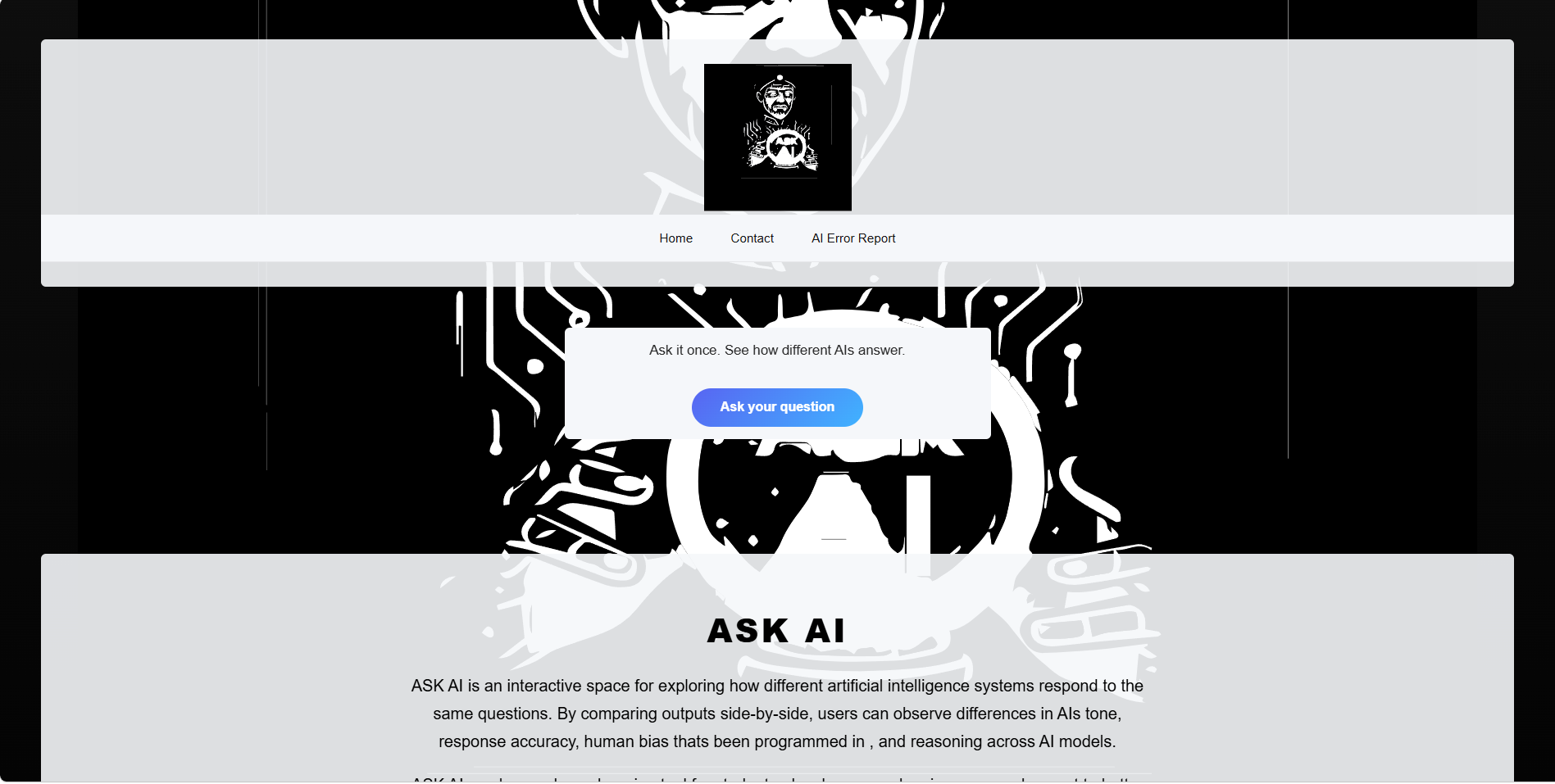
Ask AI is built around the idea that programming is not just about generating output, but about designing systems that handle input, processing, and comparison in a structured and transparent way. The project required thinking through how user questions are collected, routed, and displayed, and how multiple AI responses can be compared meaningfully within a single interface.
Central to this project is the concept of APIs. APIs act as the bridge between a website and external services, allowing applications to send requests and receive structured responses. Understanding APIs meant learning how data moves between systems, how responses are parsed, and how errors, latency, and inconsistencies must be accounted for in real-world usage.
From a programming perspective, Ask AI emphasizes system logic over surface-level interaction. The project involves managing state, handling multiple outputs, and ensuring consistent data flow between user input, AI services, and the interface.
Skills Used
- AI system comparison & data flow design
- API concepts & integration planning
- Structured interface logic
- Bias awareness in system design
JavaScript Programming


About This Project
My work with JavaScript focused on using logic to control user interface behavior rather than relying on static design. Features such as light and dark mode toggles required managing UI state, responding to user input, and dynamically updating styles in a way that remains maintainable and scalable.
Implementing light and dark mode reinforced the importance of separating concerns in web development. JavaScript handles state and events, CSS defines visual presentation, and HTML provides structure. This mirrors real-world development practices, where tightly coupled code quickly becomes difficult to debug and extend.
Additional interactive features, such as scroll-based behavior and conditional UI elements, demonstrated how JavaScript enhances usability without overwhelming the user. My approach emphasizes logic-driven behavior, clarity, and usability rather than effects alone.
Skills Used
- JavaScript (UI logic & interactivity)
- Light/Dark mode implementation
- CSS3 (responsive layouts, media queries)
- State-based UI behavior